
PA SAVIN VINELink Coverage
Pennsylvania’s VINE program is the Pennsylvania Statewide Automated Victim Information and Notification system, or PA SAVIN. The Commonwealth describes it as free and confidential. Its stated categories span county jails, Pennsylvania state prisons, and state parole. That range is useful because local custody, state confinement, and post-release supervision otherwise sit in separate systems.
PA SAVIN is event and notification infrastructure. County feeds may report release, escape, or movement to another location. State updates may cover transfer, release, escape, and recapture. The Commonwealth warns users not to rely on the service alone. It publishes no universal historical retention period, no invariant released-result schema, and no current list that guarantees live participation or identical timing in all counties.
The Pennsylvania VINELink portal is the direct statewide search entry.
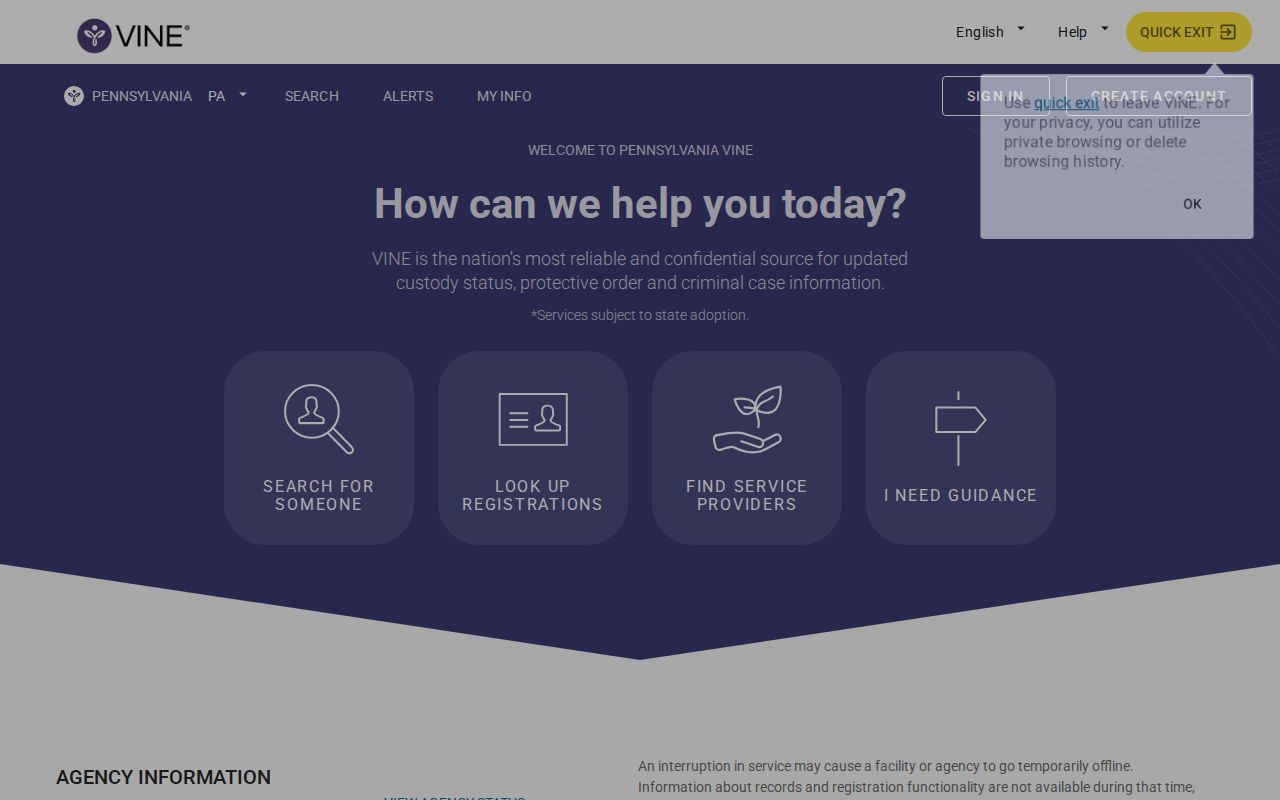
Its person search is a fast status check, not a certified archive of every Pennsylvania discharge.
Search Pennsylvania VINELink Records
Start with the custody system believed to hold the person. A Pennsylvania arrest can remain county-only and never enter the DOC locator. A state sentence can place the person in an SCI far from the committing county. VINELink can bridge those layers when the source feed participates, but it still requires a careful identity match.
- Open the Pennsylvania portal and choose the offender or person search.
- Enter the full name. Add an offender identifier or other available details when the interface and source record provide them.
- Compare facility, location, identity details, and status before selecting a record. Do not choose by name alone.
- Read the custody label and location as of the displayed update. Treat “Out of Custody” and “Paroled” as different results.
- If no record appears, check spelling and aliases, then use the source county, DOC, docket, or receiving-system search. A miss does not prove release.
For a county-jail case, the County Directory routes to the correct locality and records custodian. A county roster usually focuses on current custody, so a released person may have dropped from it even while a VINELink event remains visible for some period.
The DOC locator instructions show the separate state inmate and supervised-person modes used when VINELink needs confirmation.
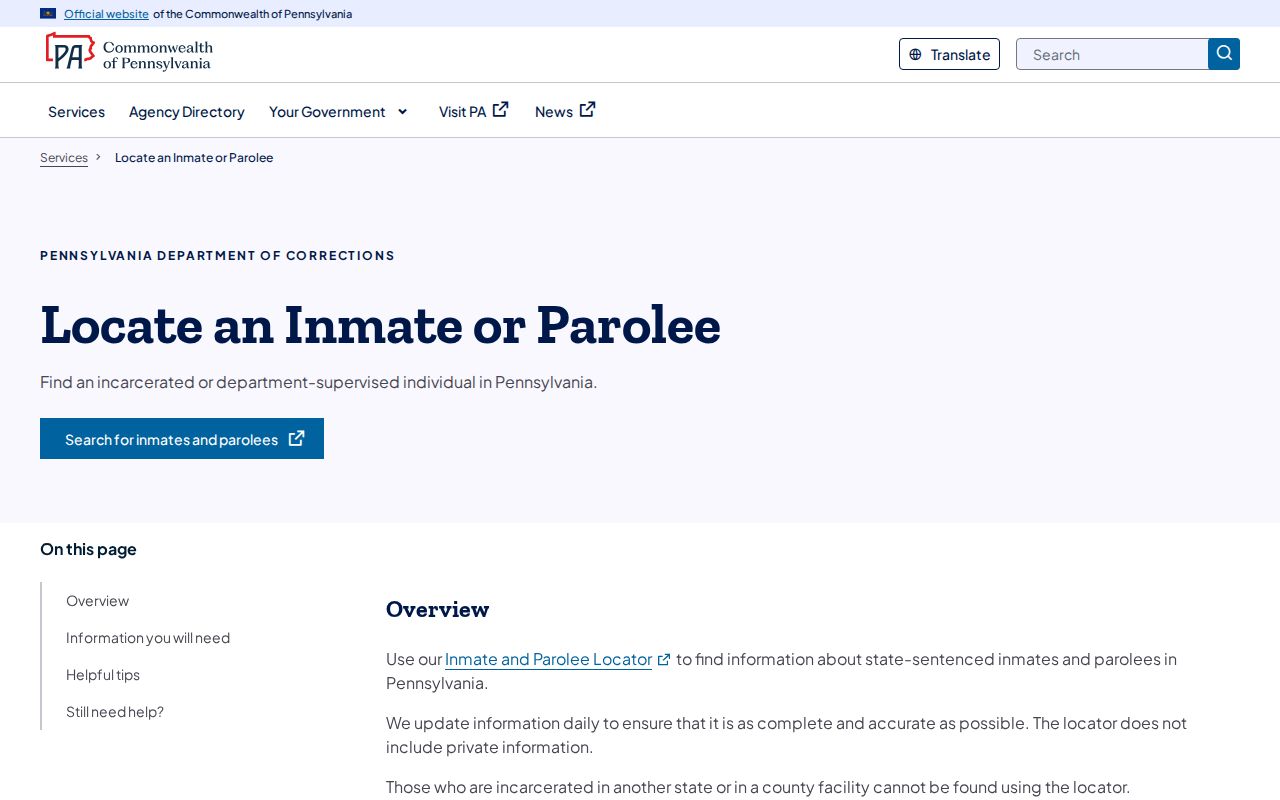
A current inmate hit supports DOC custody, while a supervised-person Release Date supports release from an SCI into supervision.
Pennsylvania VINELink Release Fields
The displayed fields depend on the participating agency’s feed and the selected record. Do not promise a fixed field list for every county or a permanent release date. Read each label literally. “Paroled” means release from confinement into supervision, not final discharge. “Out of Custody” is evidence from the source feed, but it does not identify every possible receiving authority.
| Field or label | What it can establish |
|---|---|
| Name and identifier | Helps distinguish records; identifiers are stronger than a name alone. |
| Custody status | Reports the source agency’s current category at its update time. |
| Facility or location | Names the reporting custodian or placement when supplied. |
| Out of Custody | Signals that the participating source no longer reports confinement, subject to confirmation. |
| Paroled | Shows conditional release into supervision, not completion of the sentence. |
| Event or update | May identify release, transfer, escape, recapture, or another reported change. |
Note: Pennsylvania does not publish one guaranteed period during which an out-of-custody result remains searchable in every participating feed.
Register Pennsylvania Release Alerts
Registration begins only after the correct person has been selected. Alerts can be sent through telephone, text, email, or app channels supported by the service. Multiple telephone numbers or email addresses may be registered. The PIN matters for automated calls because it acknowledges receipt and stops repeat attempts.
- Select Get Notified on the correct offender record.
- Add the desired phone, text, email, or app contact method and review the event choices shown.
- Proceed to the PIN step and create a four-digit PIN.
- Complete registration and retain the PIN. For an automated call, enter the PIN followed by #.
- If a call is not acknowledged, expect repeat attempts under the service rules, then confirm the event directly with the reporting agency.
The official PA SAVIN registration instructions explain each notification channel and the acknowledgment process.
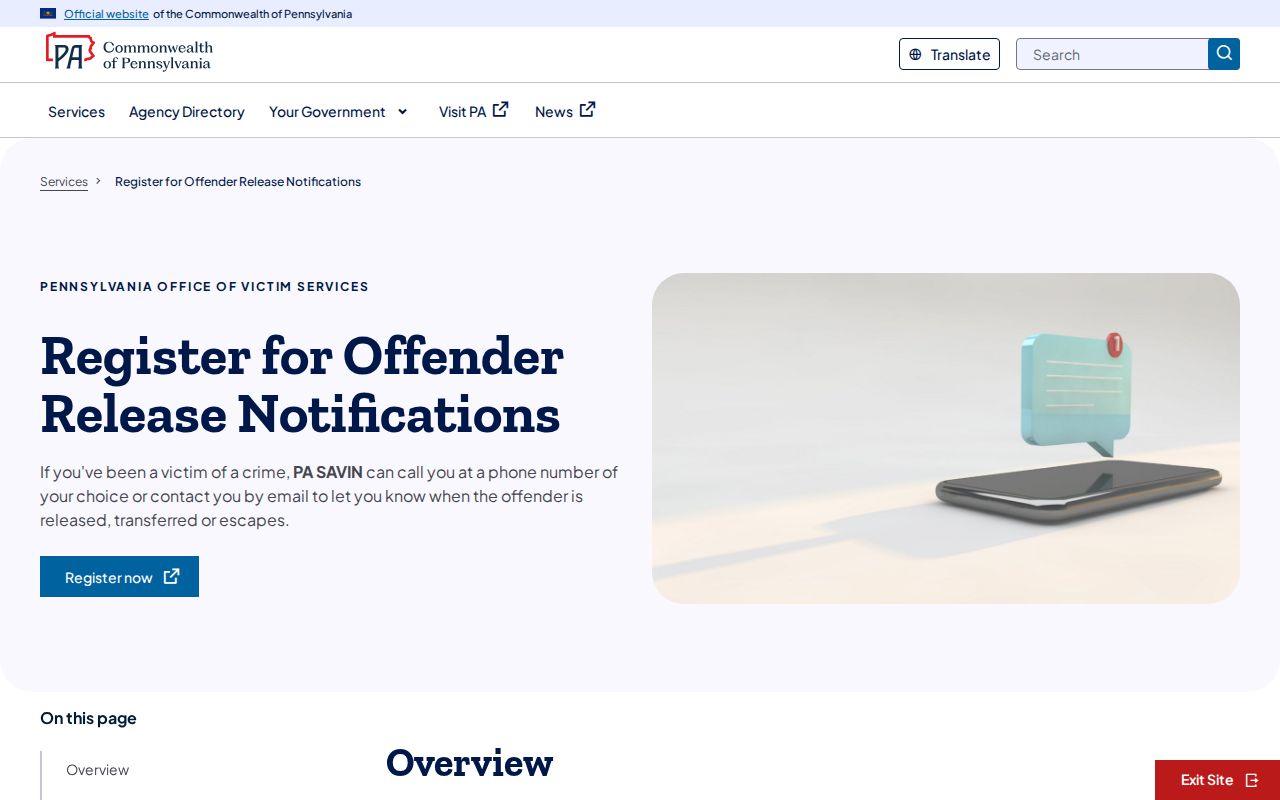
Telephone registration or help is available at 1-866-972-7284, with TTY at 1-866-847-1298.
Unanswered automated calls may repeat for 24 to 48 hours or until acknowledged. That repeat period concerns delivery attempts, not proof that the underlying custody event was correct or final. Save the source record, event time, and facility name before seeking confirmation.
Pennsylvania VINELink Release Limits
VINELink does not replace the federal Bureau of Prisons locator. Use the BOP Inmate Locator for federal custody. BOP records from 1982 onward can show a release date and location. “Released” or “Not in BOP Custody” addresses BOP custody only; it does not rule out another jail, prison, detention authority, parole, or supervised release.
The federal locator illustrates the separate search required outside PA SAVIN.
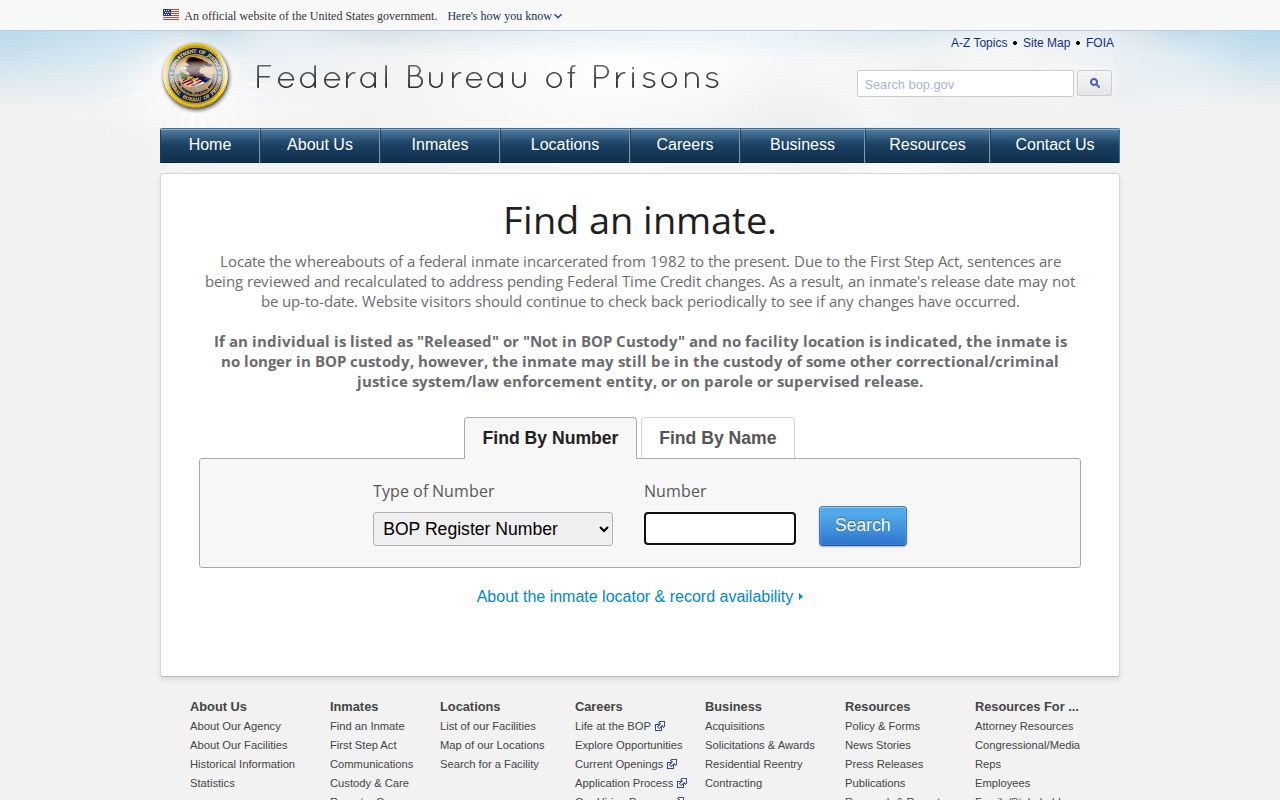
A federal result must not be merged with a Pennsylvania county or DOC result without matching identifiers and custody history.
When immigration transfer is plausible, use ICE’s locator. A county or prison release to ICE is a transfer between custodians, not community release. For a state-prison case, compare VINELink with the DOC offender search. For a county case, contact the county jail or its records officer. A UJS docket can explain the court authority for release, but it usually is not the jail’s movement log.
Feed delays, data mismatches, and agency-specific retention all limit a single-screen conclusion. The safest sequence is signal, source, and corroboration: read the VINELink event, identify the reporting agency, then confirm the status or destination with the agency record.
PA SAVIN Across Pennsylvania
PA SAVIN’s distinctive value is its reach across county jails, state prisons, and state parole. Pennsylvania has 67 counties with different local search tools and records practices. The statewide notification layer can alert across those divisions, but the Commonwealth does not publish a current nonparticipating-county list or guarantee identical event latency.
This makes PA SAVIN a strong first signal and a weak permanent archive. A release alert can prompt a timely source check. It cannot, by itself, certify final discharge, prove the absence of another hold, or establish how long the event will stay public. Record the exact label, source facility, and update time, then verify the fact that matters.
The statewide Pennsylvania released-inmates workflow uses the broader court, county, DOC, BOP, and ICE fallback chain when VINELink does not resolve the question.
Read Pennsylvania Custody Alerts
An alert should be read as a notice from a named source feed. First note the event type, facility, time, and person identifier. Release, transfer, escape, and recapture have different meanings. A transfer means custody changed hands or locations. It does not establish that the person returned to the community. A parole event can show release from confinement while state supervision continues.
Automated delivery time can differ from the underlying event time. The registration page explains that unanswered telephone calls can repeat, so a later call may describe an earlier source update. Text and email delivery can also depend on the contact channel. Use the event details rather than the moment the message was noticed.
Call the source facility or agency when timing has serious consequences. Ask whether the event was a community release, a transfer, or another custody change. If the source is a county jail, use that county’s records route. If it is DOC, compare inmate and supervised-person modes. The alert starts the verification process; it does not replace it.
Note: Keep the notification registration current, since an outdated phone number or email address can prevent delivery even when the source feed reports an event.
Pennsylvania VINELink No Results
A no-result has several possible causes. The name may be spelled differently, an alias may be on file, identity data may not match, the agency feed may be processing an event, or the person may fall outside the system’s present public scope. Final discharge is another possibility, but it cannot be proved from the miss alone.
Repeat the search with a known identifier and birth details where available. Then classify the custody. County-only cases should go to the county roster, records office, and UJS docket. State cases should go to the DOC locator and records route. Federal cases require BOP, and an immigration transfer requires ICE. These searches cannot be treated as one combined national database.
When an old VINELink result and a new no-result conflict, preserve the old event details and check the source agency. Pennsylvania does not promise how long each released record stays searchable. The absence may reflect retention or data scope rather than a reversal of the old event. A narrow records request can seek the actual movement or separation entry when public portals do not retain it.
Match Pennsylvania VINELink Identities
Common names create a real risk of selecting the wrong record. Compare every supplied identifier, facility, age or birth information, and custody history. The county or SCI should make sense in light of the known case. If the result conflicts with the UJS docket or known custodian, pause and verify before registering an alert.
A facility name alone is not enough. People can transfer, and state prisoners may be held far from the committing county. County jail cases can also move to DOC, federal, immigration, hospital, or another county custody. Use the source update date to build a sequence instead of assuming each portal describes the same moment.
For a strong verification record, note the exact search terms, result identifier, status label, facility, event date, and search date. Then add one source record from the agency or court. This small audit trail shows why the conclusion was reached and makes it easier to detect a later update without overstating what VINELink proves.
The UJS docket can add the legal basis for bail, sentence, probation, parole, revocation, or a later order. It usually does not provide the jail’s physical movement time. DOC’s supervised-person mode may add an actual Release Date for a person still on state parole, but that date is not final discharge. County records may supply the local separation entry. Each source should keep its own label.
For an alert tied to a federal case, stop and change systems. BOP records can cover federal prisoners from 1982 onward and may display a past or future release date. ICE’s locator serves a different civil detention system and includes a limited recent-release window under its rules. Neither system is part of PA SAVIN, so a Pennsylvania VINELink miss says nothing conclusive about those federal custodians.